
IMPORTANT INFORMATION
In Osceola County, residents and visitors should know several key regulations and safety guidelines regarding mopeds, e-bikes, pocket bikes, motorized bikes, and go-peds.
The risk of serious injuries for children under the age of 16 is becoming common.
Kids are not aware of the risks they may face and how they can put others in danger.
Riders must adhere to local traffic laws, including speed limits, lane usage, and stopping for traffic signals and signs.
GENERAL GUIDE TO STATE LAW REQUIREMENTS
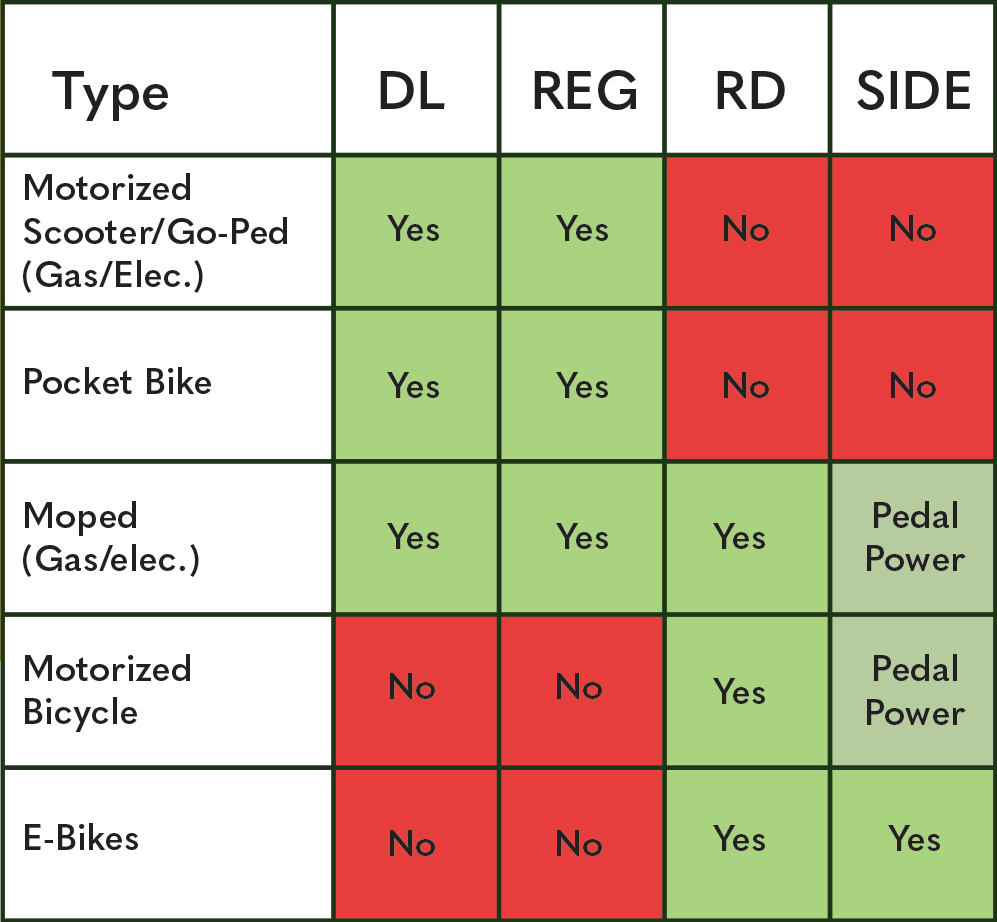
DL = DRIVER’S LICENSE
REG = REGISTRATION
RD = ROADWAY
MOTORIZED SCOOTERS, GO-PEDS, AND POCKET BIKES
A motorized scooter, as defined in section 316.003(48) of the Florida Statutes, is any vehicle or micro-mobility device powered by a motor. This device can have a seat or saddle for the rider and is designed to travel on no more than three wheels. It is also limited to a maximum speed of 20 miles per hour on level ground.
Go-peds are small, two-wheeled motorized vehicles specifically designed for personal transportation. They feature a low footboard, handlebars, and a small engine.
Motorized scooters, Go-peds, and pocket bikes do not have the required safety equipment, making them illegal to operate on roadways or sidewalks.
MOPEDS
Mopeds, as defined in section 316.003(44), are vehicles that have pedals to allow for human propulsion, feature both a seat and a saddle, and cannot exceed a speed of 30 mph on level ground.
E-BIKES
An E-Bike per section 316.003(23) A bicycle or tricycle equipped with tully operable pedals, a seat or saddle tor the use of the rider, and an electric motor of less than 750 watts which meets the requirements of one of the following three classifications:
(a) “Class 1 electric bicycle”
(b) “Class electric bicycle”
(c) “Class 3 eletric bicycle”
E-bikes typically have speed limitations depending on their class. In the United States, Class 1 and Class 2 e-bikes are usually limited to 20 miles per hour (mph), while Class 3 e-bikes can go up to 28 mph.
ELECTRIC DIRT BIKES (E-MOTOS)
An electric bike that has no pedals and cannot be operated by human power is unlawful to operate on roadways, bike lanes or sidewalks.
Legality: Not street-legal unless registered/titled as a motorcycle.
They are classified as electric dirtbikes and are only to be ridden on private property.
WHAT IS REQUIRED, AND WHERE CAN YOU RIDE A MOTORIZED SCOOTER, GO-PED, OR POCKET BIKE?
A motorized scooter or go-ped device does not need to meet the registration and insurance requirements outlined in 320.02, nor is a driver’s license required to operate it.
Individuals can ride this vehicle on private property as long as they have the landowner’s permission.
WHAT IS REQUIRED, AND WHERE CAN YOU RIDE A MOPED, MOTORIZED BIKES, OR E-BIKES?
MOPEDS:
A license and registration are required to operate this vehicle on the roadways of the state.
MOTORIZED BIKES:
No driver’s license or registration is needed for these vehicles, unless they exceed the maximum speed allowed by Florida law.
E-BIKES:
These must display a permanent label with classification details. There are no age restrictions for riding e-bikes.
E-DIRT BIKES (E-MOTOS):
Must have license plate, registration, title, and motorcycle license/endorsement to operate.
WHAT ARE THE CONSEQUENCES FOR CHILDREN AND PARENTS OF CHILDREN RIDING VEHICLES IN AN UNAUTHORIZED WAY?
- If someone is caught operating a moped, motorized bicycle, motorized scooter, go-ped, or pocket bike on a sidewalk, they will receive a moving traffic citation for using a motorized vehicle on a sidewalk, according to Florida Statute 316.1995.
- Additionally, the operator may receive a criminal citation for operating an unregistered motor vehicle.
This criminal violation requires a mandatory court date, and the operator may also face arrest, as stated in Florida Statute 320.02. - Parents who knowingly allow a juvenile without a driver’s license to operate a motor vehicle on public streets may be cited for “Permitting an Unauthorized Minor to Drive,” in violation of Florida Statute 322.35.
This is considered an arrestable misdemeanor. - To legally operate a motor vehicle in Florida, the operator must possess a valid driver’s license. If caught driving without a valid license, the operator faces a criminal citation, a mandatory court appearance, and/or arrest, as outlined in Florida Statute 322.03.